Leadership is often discussed in terms of strategy, vision, and decision-making.
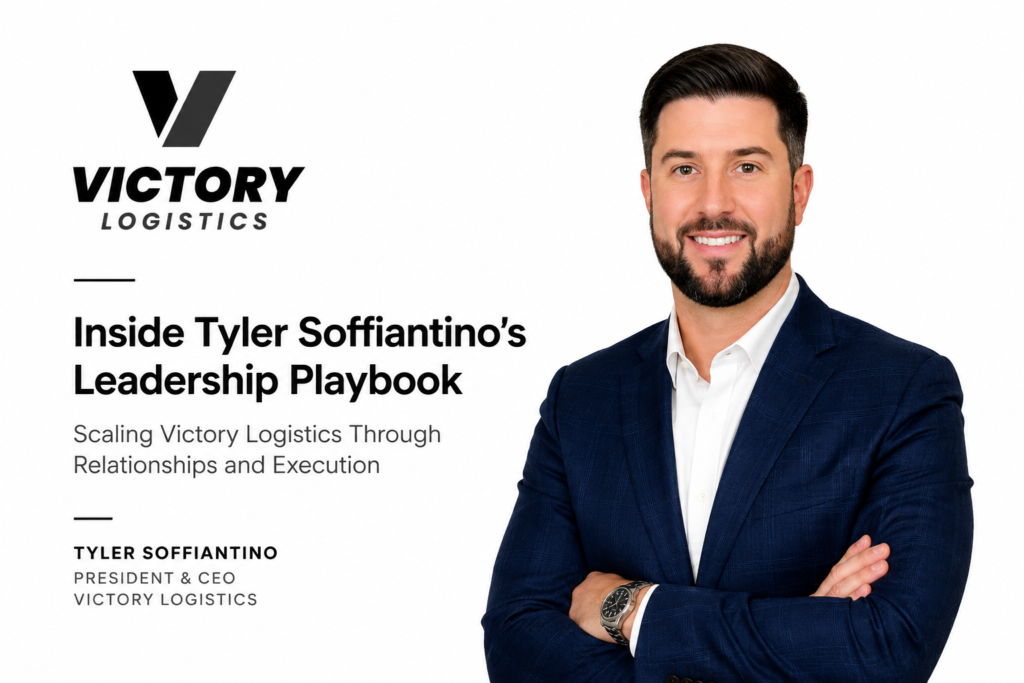
But for Tyler Soffiantino, President & CEO of Victory Logistics, leadership begins with something much simpler: consistency.
Long before he entered the logistics and transportation industry, Tyler developed many of the principles that continue to shape his leadership style today. As a former collegiate athlete, he learned firsthand the value of discipline, accountability, teamwork, and performing under pressure—lessons that would later prove just as valuable in business as they were in sports.
Today, those same principles sit at the center of Victory Logistics’ growth strategy and organizational culture.
In an industry where reliability, execution, and trust often determine success, Tyler’s leadership philosophy has helped position Victory Logistics as a logistics partner focused not only on moving freight but also on building long-term customer relationships and delivering consistent operational performance.
Leadership Begins Long Before the Boardroom
Many executives develop their leadership styles through years of corporate experience.
For Tyler Soffiantino, some of the most important leadership lessons came much earlier.
Competitive athletics provided an environment where preparation, accountability, and teamwork were not optional—they were requirements.
Success depended on:
- Consistent effort
- Personal accountability
- Trust among teammates
- Adaptability under pressure
- Commitment to a larger goal
Those same principles remain highly relevant in modern business.
Whether leading a sports team or managing a growing logistics company, success rarely comes from individual performance alone. It comes from creating systems, teams, and cultures that consistently execute at a high level.
According to Tyler, one of the biggest misconceptions about leadership is that it is primarily about authority.
In reality, leadership is often about creating alignment.
Teams perform best when expectations are clear, communication is strong, and everyone understands their role in achieving a shared objective.
Why Execution Matters More Than Ideas
The logistics industry is filled with plans.
The companies that succeed are the ones that execute.
Transportation, warehousing, freight management, project cargo logistics, and supply chain coordination all require operational discipline. Customers depend on consistency, responsiveness, and reliability.
In many ways, logistics is an execution business.
A strategy may look impressive on paper, but customers ultimately judge performance based on outcomes.
Did the shipment arrive?
Was communication clear?
Was the problem solved?
Was the commitment honored?
For Tyler Soffiantino, execution has always been one of the most important indicators of organizational performance.
This focus has helped shape the culture at Victory Logistics, where accountability and reliability are viewed as competitive advantages rather than operational requirements.
The Power of Relationship-Driven Growth
The logistics industry is often described as transactional.
Tyler believes that perspective overlooks one of the most important realities of long-term business success.
Relationships drive results.
While rates, capacity, and technology remain important, strong relationships frequently determine how effectively organizations navigate challenges when unexpected situations arise.
Supply chain disruptions, transportation delays, market fluctuations, and changing customer requirements are realities that affect every logistics provider.
When those situations occur, trust becomes invaluable.
Businesses want partners who understand their operations, communicate effectively, and remain committed to finding solutions.
This relationship-focused approach has become a key component of Victory Logistics’ growth strategy.
Rather than focusing exclusively on transactions, the company prioritizes long-term partnerships built on reliability, transparency, and mutual success.
Over time, these relationships often become one of the most valuable assets a business can develop.
Building Victory Logistics Through Consistency
Entrepreneurial growth is often portrayed as a series of major breakthroughs.
In reality, sustainable growth is usually the result of consistent execution over time.
Victory Logistics has continued expanding its capabilities across transportation, supply chain management, freight coordination, warehousing solutions, project cargo logistics, and heavy haul transportation by maintaining a disciplined focus on customer service and operational performance.
For Tyler Soffiantino, growth is not simply about acquiring new customers.
It is about creating systems and processes capable of supporting long-term success.
This philosophy influences everything from team development and customer relationships to logistics strategy and operational planning.
The objective is not short-term momentum.
The objective is sustainable performance.
Leadership During Uncertainty
Leadership is easy when conditions are favorable.
The real test occurs when challenges emerge.
Economic uncertainty, supply chain disruptions, transportation market fluctuations, and operational obstacles have become increasingly common across industries.
During these periods, organizations often look to leadership for stability and direction.
According to Tyler, some of the most important leadership qualities during uncertain times include:
- Maintaining composure
- Communicating clearly
- Making informed decisions
- Remaining accountable
- Focusing on solutions
These characteristics help create confidence within teams and provide customers with reassurance that challenges are being actively managed.
In logistics, where disruptions can occur at any stage of the supply chain, this mindset becomes particularly important.
Lessons Beyond Logistics
While logistics remains the primary focus of Victory Logistics, Tyler’s leadership philosophy extends into other business initiatives as well.
His involvement in the Name, Image, and Likeness (NIL) space reflects a similar belief in building sustainable systems rather than pursuing short-term opportunities.
Whether supporting logistics operations or developing NIL-related business models, the underlying principles remain remarkably consistent:
- Build strong relationships
- Create scalable systems
- Focus on long-term value
- Prioritize execution
- Maintain accountability
These principles transcend industries and continue to guide decision-making across multiple business environments.
The Future of Leadership in Logistics
As supply chains become increasingly complex and customer expectations continue evolving, leadership within the logistics industry will require a combination of operational expertise, strategic thinking, and relationship management.
Technology will continue transforming transportation and supply chain operations.
Data will become more important.
Visibility will increase.
Automation will expand.
Yet many of the qualities that define successful leadership will remain unchanged.
Trust.
Accountability.
Consistency.
Execution.
For Tyler Soffiantino, these principles have played a central role in both personal and professional growth.
They helped shape his approach as an athlete.
They continue to guide his leadership at Victory Logistics.
And they remain at the center of a philosophy that views long-term success not as the result of isolated achievements, but as the product of disciplined execution repeated consistently over time.
Because businesses do not scale on transactions alone.
They scale on relationships.
They scale on trust.
And they scale on leadership that delivers.